Citizen reporting platform
Making odours visible.
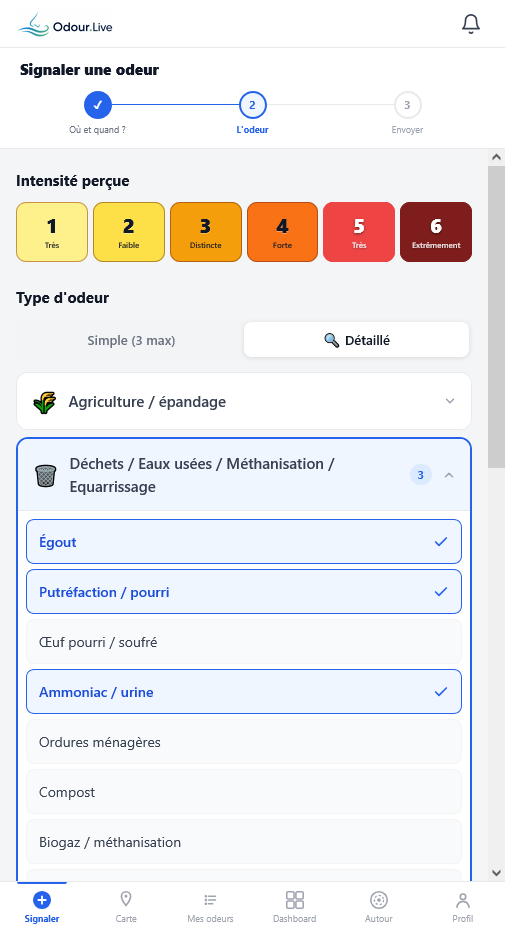
Report an odour nuisance in under a minute.
Every report counts.
Find out here how Odour.Live can help local residents and citizens.
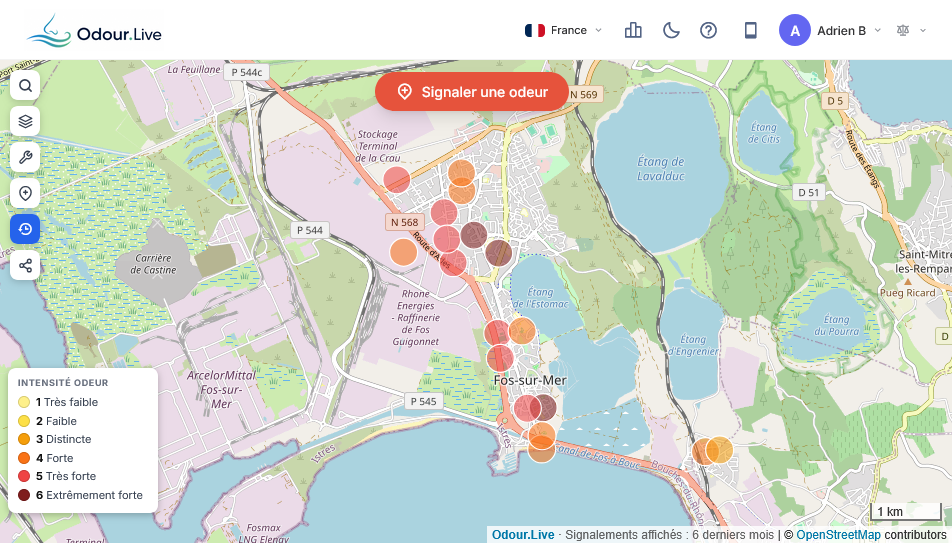
Anonymous reporting
No tracking cookies, compliant with the French CNIL and the GDPR
Under 1 minute
To make a report: no registration, account or e-mail needed
Free
Citizens, associations, municipalities and journalists
By and for citizens
To improve odour comfort
Open data
Data you can access and visualise
Perception
Not everyone perceives an odour in the same way
You smell a strong odour? Your neighbour, hardly anything? That's normal. The perception of an odour is personal: sense of smell, timing, context, memories... no two people experience it the same way.
A variable perception, a very real nuisance
There is no perfectly objective link between the presence of an odour and the nuisance it causes. The nuisance depends both on actual exposure and on individual perception. This variability does not call into question the reality of a nuisance: on the contrary, it underlines the importance of accumulating reports, in several places and at different times, to better establish the facts about each episode.
A nuisance
How to tell an odour from an odour nuisance?
Odour nuisance is generally characterised by five complementary criteria: Frequency, Intensity, Duration, Offensiveness and Location (the FIDOL factors). Together, they help explain why the same odour can be experienced very differently from one person to another or at different times.
Frequency
Once a month or every day: not the same impact
Intensity
Intensity ranges from “very weak” to “extremely strong”
Duration
A peak lasting a few seconds or odours lasting several hours
Offensiveness
Fresh bread vs sewage? Same intensity, different experience
Location / context
Acceptable in an industrial area, disturbing in a bedroom or a garden
Accumulating reports
Why report?
And why on odour.live?
A single report is a testimony of a one-off situation. Repeated and accumulated reports make it possible to document the situation objectively over time, and thus to better assess the reality and scale of a nuisance, especially when it may exceed the normal constraints of living together and amount to an abnormal neighbourhood disturbance.
Citizen-led
Independent of the operator, usable and visible by everyone, with no prerequisites or account
Breaking isolation
Unlike data collected by the operator, you realise that you are not alone
Strengthening a collective approach
Alongside a petition or a letter to the town hall
Anonymous and cookie-free
An account is optional, we do not exploit your personal data
Establishing the facts
The reality of nuisances based on dated and located observations, rather than isolated testimonies
Building a history
Usable in discussions with the operator, the town hall or government services
Highlighting patterns
Recurrence and changes depending on the weather or periods of activity
Improving the situation
Reporting helps the operator identify the causes and improve the situation
Action
What next?
Five steps, from your report to a collective approach.
Step 1
Share and centralise
Share your report and the website on social media. Encourage your neighbours to do the same and centralise the reports.
Step 2
Alert
Simply forward the e-mail you received (if you asked for one when reporting) to the operator, the town hall and the relevant state services (in France: DREAL/DDPP).
Step 3
Formalise
Write a letter describing the odours as a “nuisance”, using the reports accumulated in your member area.
Step 4
Conciliate
No answer? Contact a conciliator of justice (free in France) and your mayor, who can refer the matter to the prefecture.
Step 5
Join forces
Residents' committee or association: there is strength in numbers to carry these steps forward!
Collective
Then, join forces
Move from scattered testimonies to a documented collective file. Individual reports are aggregated and analysed together to build a real history of the nuisance, usable in administrative procedures, in discussions with the operator and, if necessary, in legal action.
Residents' committee
A group (WhatsApp, Facebook, Signal...) is enough to get started
Registered association
A legal framework to act and carry a collective voice (in France: “loi 1901” association)
Carrying the group's voice
Ready to lead a collective approach? Discover our page for community groups and associations
The more regularly residents report, the more visible and objective the situation becomes. This approach complements petitions and other existing channels (letters to the town hall, reports to government services, discussions with the operator). Starting a petition shows that residents are asking for action. Regular reports document why that action is needed. The two approaches go hand in hand.
Legal framework
What do the regulations say?
How to act?
What French law provides, who to contact, and in what order. The legal texts quoted below are unofficial English translations of French law.
General information about French law, not legal advice.