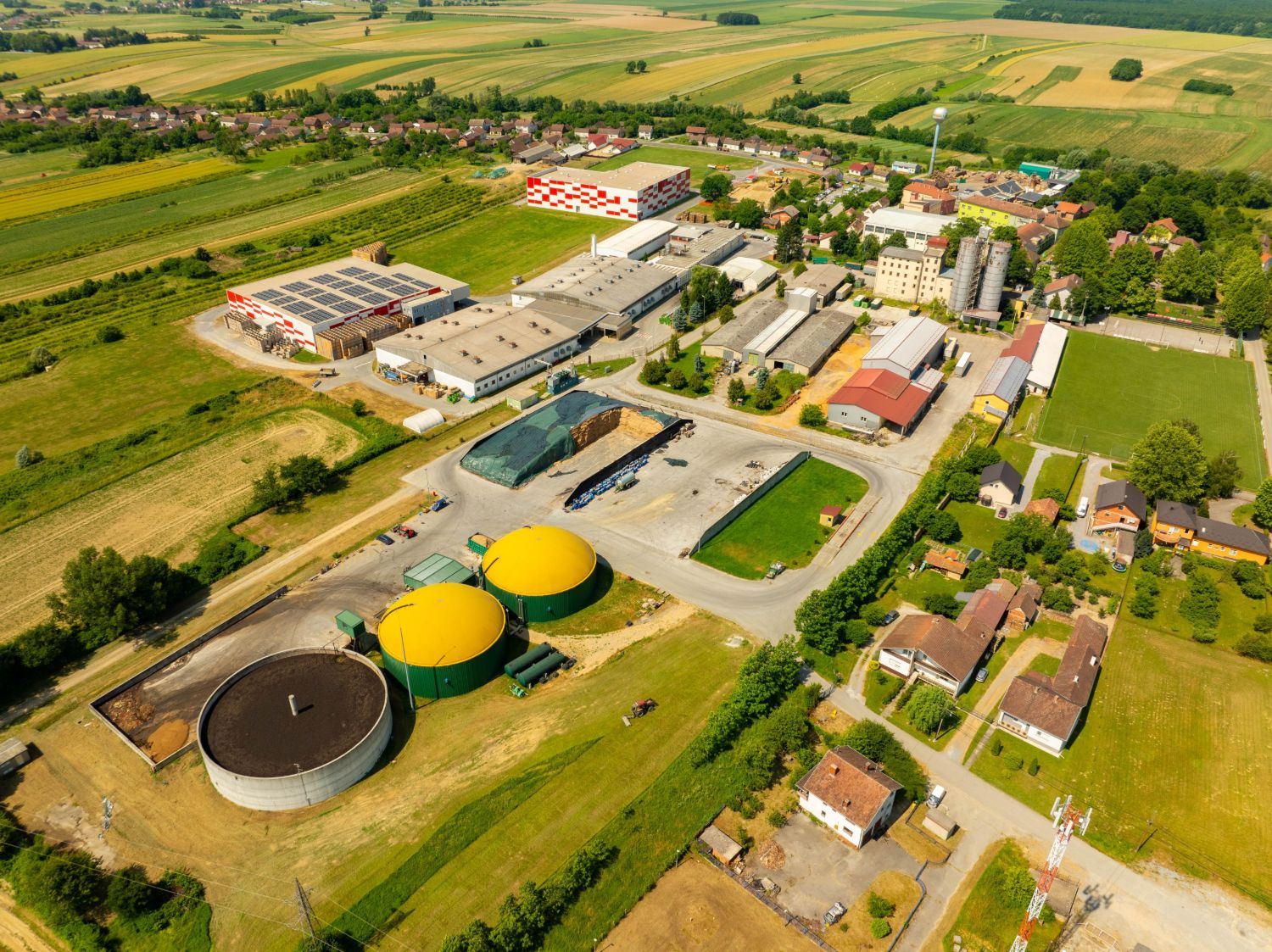
Understanding odours around an anaerobic digestion plant
What these odours are, why they occur, and why your report matters
Anaerobic digestion is expanding in many areas as part of energy planning and the energy transition (PPE 3: French multi-annual energy programme). It legitimately raises questions, particularly about the odours noticed by residents. This page aims to explain, clearly and objectively and based on the available scientific and regulatory knowledge, where these odours come from, how to recognise them, and what to do if they bother you.
Anaerobic digestion (also called methanisation) is a natural biological process: micro-organisms break down organic matter in the absence of oxygen, in a closed tank called a digester. This process, similar to what happens in a marsh or in the stomach of a ruminant, turns organic matter into two useful products: biogas and digestate.
Incoming materials (feedstock)
An anaerobic digestion unit can be fed with different types of organic matter:
- Livestock manure: slurry, solid manure
- Biowaste: food waste from households, catering and the food industry
- Agricultural residues: crop or silage residues, catch crops grown for energy (CIVE)
- Food-industry co-products: processing by-products (dairies, sugar factories, breweries, etc.)
The resulting products
- Biogas, which can be used to produce electricity and heat, or upgraded into biomethane injected into the natural gas grid
- Digestate, the residue of fermentation, used as an organic fertiliser spread on farmland
How a plant works
The process takes place in closed, airtight digesters (the tanks with a dome on top). In most recent plants, the buildings where materials are received are enclosed and connected to an air treatment system (biofilter or air scrubber) that captures and neutralises odorous compounds before release into the atmosphere. Some products may be stored outdoors (silage clamp) so that the operator can balance what goes into the digester.
Key point
In normal operation, a properly designed, well-run and well-maintained unit should not cause significant odour nuisance beyond its property boundary. A noticeable, recurring odour may point to a malfunction or a practice that needs correcting.
Agricultural digestion vs biowaste digestion
Not all anaerobic digestion units have the same odour risk profile. The table below compares the two main families of projects found in Europe. The size of the operation also matters: agricultural digestion plants are often small and linked to existing livestock farms, with regular, local flows. Multi-feedstock plants are often larger and their feedstock comes from more or less nearby sites (farms, food industry, etc.). For these, the odour risk is often higher because of variations in feedstock and in the volume processed.
| Criterion | Agricultural digestion | Biowaste / multi-feedstock digestion |
|---|---|---|
| Main feedstock | Livestock manure, crop residues, catch crops | Household biowaste, catering waste, agro-industrial co-products, sometimes livestock manure |
| Odour potential of feedstock | Moderate (relatively stable materials, often stored on the farm) | More variable and sometimes higher (highly fermentable materials that rot more quickly) |
| Logistics | Flows often internal to the farm, more regular and predictable deliveries | Multiple external flows, deliveries from third parties, more frequent deliveries. Sometimes requires temporary on-site storage |
| Typical odour risks | Silage storage, spreading of digestate | Reception and unloading of biowaste, buffer storage of fresh materials |
Sources: ADEME – Anaerobic digestion • INERIS / AIDA – ICPE heading 2781 • ATEE – Club Biogaz • Atmo France
Even a well-managed plant can at times cause noticeable odours. Most of these situations are occasional and identifiable. The table below lists the main odour sources observed around anaerobic digestion units.
| Odour source | Description | Why does it smell? | Frequency | Typical timing |
|---|---|---|---|---|
| Reception of materials (lorries, unloading) | Unloading of feedstock into reception pits or hoppers | Fresh or already decomposing materials are opened; mixing releases volatile compounds | Frequent but brief | Working hours, during deliveries |
| No enclosure / open doors | Reception building not closed during an operation (and sometimes left open) | Air laden with odorous compounds is no longer captured by the air treatment system | Occasional to frequent depending on the operator | Variable |
| Temporary outdoor storage (feedstock or digestate) | Open-air windrows or pits awaiting treatment or spreading | Fermentation in the open air, not enclosed | Occasional to frequent depending on the operator | Day and night |
| Silage storage | Clamps or covered heaps of catch crops intended for the digester | Lactic/acetic fermentation typical of silage | Frequent during the storage season | All year round, peaks when opened or when material is removed |
| Opening of tanks (maintenance) | Technical work requiring a digester to be opened | Brief, concentrated release of fermentation gas | Rare, scheduled | Daytime, limited duration |
| Vents, valves, safety devices | Safety devices releasing gas in the event of overpressure | Direct release of untreated biogas, a safety measure | Rare | Unpredictable |
| Biogas leaks / foul air | Faulty seal on a pipe, joint or piece of equipment | Direct escape of biogas (typical H2S smell) | Rare with proper maintenance, but can happen | Variable |
| Biological imbalance in the digester | Overloading, unsuitable feedstock or sudden temperature change | Abnormal fermentation producing more sulphur compounds | Occasional to frequent | Can last several days |
| Saturated or poorly maintained biofilter (or no biofilter) | The filter medium of the air treatment system loses its effectiveness | Air is no longer properly cleaned before release | Occasional if maintenance is insufficient, becoming continuous in case of failure | Gradual, worsens over time |
| Spreading of digestate | Application of digestate as fertiliser on farmland | Organic matter spread in the open air, smell comparable to ordinary manure spreading | Occasional, depending on the farming calendar | Spring/autumn, a few days |
Weather factors affecting how odours are perceived
The weather does not create odours, but it strongly changes how they disperse and how residents perceive them:
- Light wind: odorous compounds linger near the source instead of dispersing
- Temperature inversion (often in the morning or evening): cold air stays close to the ground, preventing odours from rising and diluting. This is what you can see in autumn or spring when there is mist early in the morning, for example.
- Heat: it speeds up fermentation and increases the volatility of odorous compounds (at the plant itself as well as in feedstock or waste storage and in associated lagoons)
- Humidity: it helps odour molecules persist in the air
Did you know?
The same plant can seem “odour-free” for several weeks, then occasionally cause a nuisance on a calm, humid morning without any malfunction being involved. That is why weather conditions (wind, temperature, time) are valuable information to note when reporting.
Sources: ADEME / Atmo France – AQAMETHA project • Atmo Hauts-de-France – StoryMap on anaerobic digestion odours • INERIS – studies on odours and anaerobic digestion
Odours linked to anaerobic digestion cannot be reduced to a single olfactory signature. Depending on the source, several types of odour can be perceived, associated with different chemical compounds.
| Odour perceived | Descriptor | Associated compound | Possible source | Timing |
|---|---|---|---|---|
| Rotten eggs | Sulphurous, pungent | Hydrogen sulphide (H2S) | Biogas leak, tank opening, digester imbalance | Occasional, often brief |
| Ammonia | Pungent, irritating | Ammonia (NH3) | Digestate, spreading, storage of nitrogen-rich materials | Spreading, prolonged storage |
| Slurry | Animal, strong | Nitrogen and sulphur compounds | Livestock manure at reception or in storage | Reception, storage |
| Manure | Earthy, animal | Various organic compounds | Storage of solid manure | Outdoor storage |
| Silage | Sour, fermented | Organic acids (lactic, acetic) | Catch crop clamps | When opened, all year round |
| Fermented biowaste | Putrid, sickly sweet | Volatile organic compounds (VOCs) | Reception of biowaste | Delivery, unloading |
| Vinegar / acid | Pungent, sour | Volatile fatty acids (VFAs) | Digester slightly out of balance, storage of fresh digestate | Variable |
| Solvent / chemical (rare) | Chemical, penetrating | Specific VOCs depending on feedstock | Unconventional industrial co-products | Rare, occasional |
| Alcoholic fermentation | Sweet, alcoholic | Compounds from sugar fermentation | Food-industry co-products (fruit, sugar factories) | Reception, storage |
| Greasy / rancid odours | Greasy, rancid | Long-chain fatty acids | Fatty co-products (oils, animal or vegetable fats) | Reception, storage |
The compounds in a nutshell
- H2S (hydrogen sulphide): gas produced when sulphur-rich matter breaks down; detectable by the human nose at very low concentrations, well below any danger threshold (see INRS)
- NH3 (ammonia): produced when nitrogen-rich matter breaks down, typical of digestate and livestock manure (see INRS)
- VOCs (volatile organic compounds): a broad family of volatile carbon-based molecules, behind many fermentation odours
- Volatile fatty acids (VFAs): intermediate products of anaerobic digestion, responsible for sour or “vinegary” notes
Sources: Atmo Hauts-de-France – StoryMap: anaerobic digestion odours • Atmo France • INERIS – air quality • INERIS - Chemical Substances Portal
In France, anaerobic digestion units are Installations Classified for Environmental Protection (ICPE), governed by heading 2781. The level of oversight depends on the size and nature of the plant:
- Declaration (D): small-capacity plants (less than 30 t/day of material processed), subject to general requirements and periodic inspection (Article 6.2 of the Order of 10/11/09)
- Registration (E): simplified procedure with standardised technical requirements, without a systematic impact assessment. The operator must however carry out a survey of the odours perceived around the site before the plant is commissioned (baseline), (Article 49 of the Order of 12/08/10)
- Authorisation (A): the largest plants, subject to a detailed impact assessment (including modelling), a public inquiry and specific prefectural requirements (Article 29 of the Order of 10/11/09)
The applicable regime depends on how the plant is classified. For plants subject to authorisation, the impact assessment evaluates in particular the expected odour nuisance and the measures planned to limit it. Once in operation, the operator must comply with the requirements set by prefectural order, and the plant is inspected by the DREAL (regional directorate for the environment, planning and housing).
Main obligations relating to odours
- Enclosure of odour sources (reception buildings, unloading areas)
- Treatment of extracted air (biofilter, air scrubber) before release into the atmosphere
- Controlled management of storage (covering, limited duration, dedicated areas)
- Prevention of biogas leaks through regular equipment maintenance
- Maintenance and monitoring of the proper functioning of air treatment systems
- Monitoring of nuisances and implementation of appropriate prevention and management measures
French regulations on odours from classified installations (illustrated by the Order of 12/08/10 for anaerobic digestion) are based on three fundamental principles that shape the approach to prevention and control:
1. Prevention at source
The operator must put in place systematic preventive measures to stop odour nuisance before it occurs. This includes:
- Enclosure of sources: facilities likely to release odours must as far as possible be housed in enclosed premises, ventilated if necessary
- Strategic siting: potential odour sources that are hard to enclose (basins, lagoons) must be positioned taking the prevailing wind direction into account to limit disturbance to neighbours
- Regular maintenance: a preventive maintenance programme must be drawn up to periodically check the airtightness of equipment (every six months for critical systems) and the breather valve
- Prevention of anaerobic conditions: the operator must take all measures to limit odours, in particular by preventing anaerobic conditions from forming in storage basins or open channels
- Treatment of gaseous effluents: ducted odorous gaseous effluents must be collected and sent to a treatment unit (biofilters, gas scrubbers)
2. Obligation of result: traceability and response
The operator is responsible for achieving a quality objective without being bound to specific means. This objective is expressed as a quantified limit:
“The odour concentration attributable to the installation in areas of human occupation within a radius of 3,000 metres of the fenced boundaries of the installation must not exceed the limit of 5 ouE/m³ for more than 175 hours per year (i.e. an exceedance frequency of 2%).”
This obligation of result implies:
- Documented baseline: before commissioning, the operator must establish the existing odour perceptions in the surrounding area in order to assess the impact of the plant
- Complaints register: the operator must keep an up-to-date complaints register including the date, time, location, weather conditions and correlation with critical operations
- Mandatory diagnosis in the event of exceedance: if significant nuisances are reported, the operator must commission a diagnosis and a dispersion study to identify the problem sources and make changes
- Operating log: the operator must document critical operations (start-up, shutdown, emptying) that are more likely to generate odours
3. Freedom of means: a flexible, context-based approach
The regulations do not impose specific technical means, but require the operator to justify the choice of its measures and their suitability for the local context:
| Aspect | Regulatory flexibility |
|---|---|
| Technology choices | The operator can choose between full enclosure, active treatment (biofilters, scrubbers) or combinations suited to its plant and surroundings. |
| Odour measurement | Measurement methods are only mandatory in the event of complaints; no systematic measurement is required when there is no problem. |
| Local sensitivity | Exemption for isolated sites: nuisance prevention measures do not have to apply “where the surroundings of the installation are of particularly low sensitivity, in particular where there is no human occupation within a radius of 1 kilometre”. |
| Gradual adaptation | In case of difficulties, the operator can adapt its measures gradually: three-yearly checks of treatment equipment, adjustment of critical operations, revision of the maintenance programme. |
| Justification of compliance | The order requires the operator to “list and justify as necessary all the measures taken” to comply with the requirements — which rewards adaptation to the specific context of the site. |
Key point
The ICPE regulations impose precise obligations to limit odour nuisance. A documented report (date, time, weather conditions, intensity, description of the odour) helps the inspection services check that these obligations are being met.
Sources: AIDA / INERIS – ICPE heading 2781 • French Ministry for the Ecological Transition • INERIS – ICPE and odour nuisance management
Noticing an odour near an anaerobic digestion site is not abnormal in itself: some occasional emissions (delivery, spreading, opening of a silage clamp) are expected and generally brief. On the other hand, an intense, recurring or unusual odour may reveal a malfunction that is worth reporting.
Situations that are usually normal
- A brief odour during a delivery or unloading
- A silage smell when a clamp is opened
- A spreading odour limited in time, comparable to ordinary manure spreading
Situations to report
- A strong odour lasting several hours or days
- A new, unusual odour, or one very different from what is usually noticed
- An odour associated with repeated nuisance, especially at night or early in the morning
Every report, even for a nuisance that seems modest, helps to establish the facts around a plant and, where necessary, to guide corrective action by the operator or inspections by the authorities. National studies such as AQAMETHA show that dialogue and information-sharing with residents are among the levers for improving air quality and the acceptability of the sector.
Key point
Reporting an odour is neither excessive nor pointless: it is a tool for shared environmental vigilance. The more precise the reports (date, time, duration, intensity, weather), the more useful they are for identifying possible malfunctions and improving the situation.
A single report is hard to act on. A history of time-stamped, geolocated odour episodes, on the other hand, is usable factual evidence — whether to alert the DREAL, support a request to the operator, or document a private nuisance case.
As a registered member, access a report-to-administration form with a letter template pre-filled from your report history.
Access the letter templateIs an anaerobic digestion plant near you giving off an abnormal odour right now?
Report this odour